The Hidden Revenue in Your Support Inbox
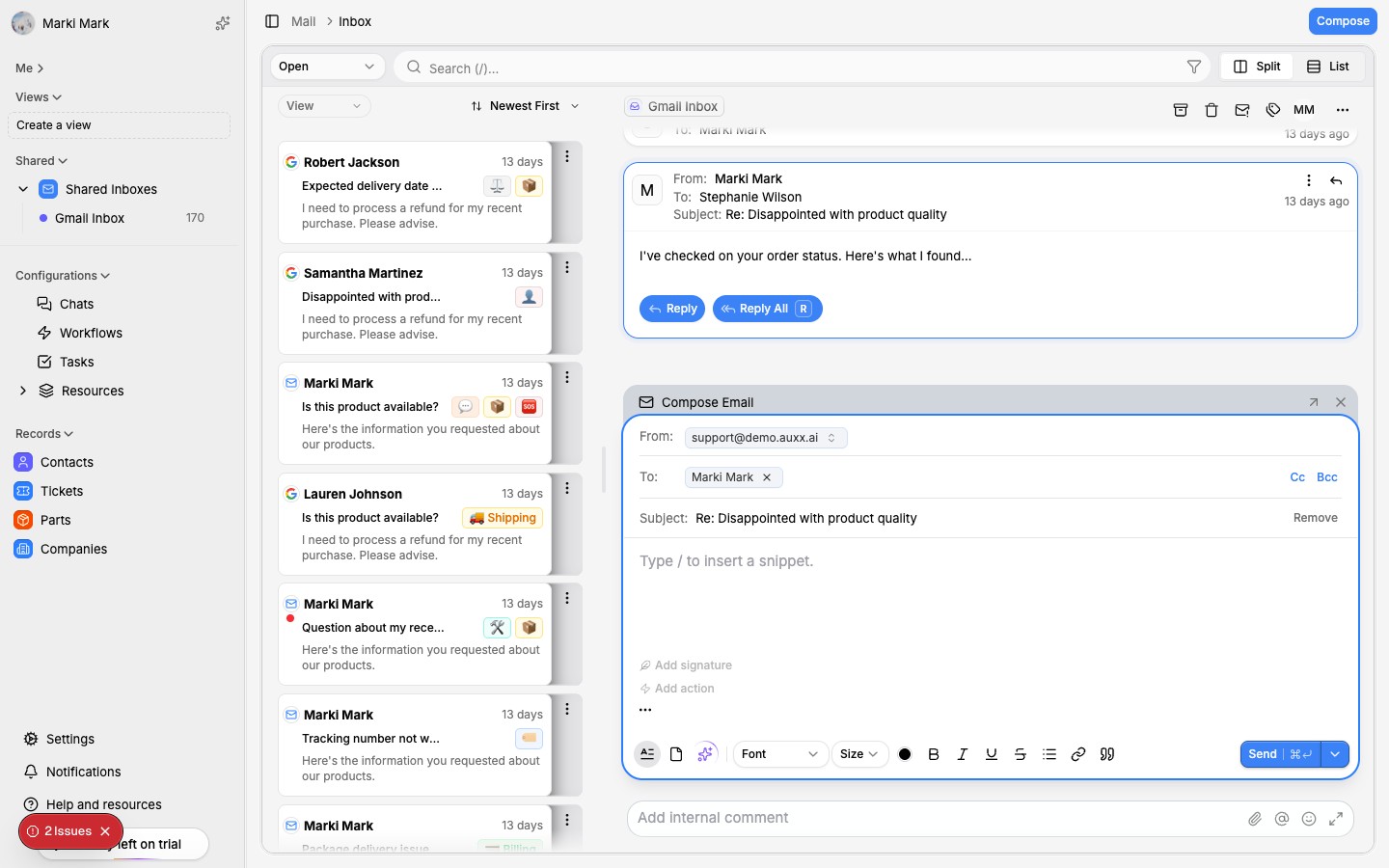

Your support inbox isn't a cost center — it's a revenue channel you're probably ignoring.
Support is not a cost center
Most store owners look at their support inbox and see a cost. Headcount. Software subscriptions. Time that could be spent on growth. The default assumption is that support is the price you pay for selling things.
That assumption is wrong.
Your support inbox is a revenue channel. Every day, customers are telling you exactly what they need to buy, what's stopping them from buying, and what would make them buy again. The only question is whether you're listening — and responding fast enough to capture that revenue.
Let's do the math.
Pre-sale questions are purchase signals
When someone emails asking "does this come in blue?" or "will this fit a 6-foot shelf?" — they're not browsing. They're ready to buy. The only thing between them and checkout is your answer.
The data is clear:
- Customers who get a pre-sale answer within 1 hour convert at 3-5x the rate of those who wait longer
- The average e-commerce store receives 15-25% of support volume as pre-sale questions
- The average unanswered or slow-answered pre-sale email represents $50-150 in lost revenue
Do the math for your store. If you get 10 pre-sale questions a day and miss or slow-respond to half of them, that's 5 lost sales. At a $75 average order value, that's $375/day. $11,000/month in revenue you're leaving on the table.
And these are conservative numbers. For stores selling higher-ticket items, the numbers are significantly larger.
If you want to understand the full financial impact of slow responses, check out our breakdown on the cost of slow Shopify customer support.
The save rate: turning refunds into revenue
A customer emails asking for a refund. Most stores process it and move on. But that's not the only option.
Great support teams have a "save rate" — the percentage of refund requests they convert into exchanges, store credit, or retained orders. The best teams save 25-40% of refund requests.
Here's how:
- Understand the real problem. "I want a refund" often means "this isn't what I expected." Dig into why. Wrong size? Wrong color? Doesn't match the photos? Each of these has a solution that isn't a refund.
- Offer alternatives. Exchange for the right size. Store credit with a small bonus (10% extra). A different product that better fits their needs.
- Fix the issue. Sometimes the product just needs a usage tip or a minor adjustment. A quick explanation can turn a refund into a satisfied customer.
Let's say you process 100 refund requests a month at an average order value of $80. If you save 30% of those, that's 30 orders retained — $2,400/month in saved revenue. That's $28,800/year, from a process change that costs nothing.
Repeat purchase correlation
This is the number most store owners don't track: the relationship between support quality and repeat purchases.
Customers who have a positive support interaction are 2-3x more likely to buy again compared to customers who never contacted support. That sounds counterintuitive — wouldn't it be better if they never had a problem?
Not necessarily. A customer who had an issue and got it resolved quickly and painlessly now has proof that your store stands behind its products. That trust is worth more than a frictionless first purchase.
The flip side is brutal. Customers who have a negative support experience are almost guaranteed to never buy again. And they tell people. Research shows dissatisfied customers tell 9-15 people about their experience.
The lifetime value math
A one-time customer is worth their average order value. A repeat customer is worth 3-5x that over their lifetime.
If great support converts even 10% more customers into repeat buyers, the revenue impact is massive. For a store doing $50k/month with a 20% repeat rate:
- Current repeat revenue: $10k/month
- With 10% improvement: $15k/month
- Annual impact: $60k in additional revenue
This is revenue that compounds. Those repeat customers tell friends. They leave reviews. They become the foundation of a sustainable business.
For more on the metrics that drive this, see our guide on Shopify customer support metrics.
Upsell and cross-sell in support conversations
Your support team talks to more customers than anyone else in your company. Every conversation is an opportunity — not for a hard sell, but for a relevant recommendation.
Natural upsell moments
- "How do I use this product?" — recommend the complementary product that makes it work better
- "I need a replacement part" — suggest the upgraded version
- "I love this, do you have anything similar?" — recommend related products
- "I'm buying this as a gift" — suggest gift wrapping or a bundle
The key word is natural. These recommendations only work when they genuinely help the customer. Shoehorning a product pitch into a complaint about late shipping will backfire.
The numbers
Stores that train support teams on relevant recommendations see a 5-15% increase in average order value on tickets that include a recommendation. Not every ticket is an opportunity — maybe 20-30% are. But on those tickets, the impact is real.
For a store handling 1,000 tickets/month with an $80 AOV:
- 250 recommendation-eligible tickets
- 10% conversion rate on recommendations
- 25 additional sales at $80 = $2,000/month in incremental revenue
That's revenue that requires zero additional customer acquisition cost. The customer is already in your inbox.
Calculating your support ROI
Most stores can't answer a simple question: what is the revenue impact of your support operation?
Here's a framework:
Revenue generated
- Pre-sale conversions — track emails that lead to purchases within 48 hours
- Saved refunds — count exchanges and retained orders from refund requests
- Repeat purchases — compare repeat rates between supported and unsupported customers
- Upsell revenue — track orders placed during or immediately after support conversations
Revenue protected
- Prevented chargebacks — each chargeback costs $15-25 in fees plus the order value
- Retained customers — customers who would have churned without good support
- Word of mouth — harder to measure, but real. Happy customers refer.
The full picture
Add up the revenue generated and protected. Then compare it to your support costs (people, tools, time). For most stores, support generates 3-8x its cost in revenue when done well.
The problem isn't that support doesn't generate revenue. The problem is that most stores never measure it. So they treat support as a cost to minimize rather than a channel to invest in.
Understanding what customers actually want from support is the first step to capturing this revenue consistently.
How AI captures revenue you're missing
The biggest source of lost revenue in support isn't bad answers. It's slow answers and missed messages.
A pre-sale question that comes in at 9 PM on Friday doesn't get answered until Monday morning. By then, the customer bought from a competitor. A refund request that sits for 6 hours can't be saved — the customer has already filed a chargeback.
AI-powered support fixes this by eliminating the delay:
- Instant responses to pre-sale questions — no more lost sales to slow response times
- 24/7 coverage — revenue doesn't stop at 5 PM, and neither does your support
- Automatic context — AI pulls order data and customer history, so every response is relevant and personalized
- Consistent save attempts — AI can offer exchanges and alternatives on refund requests every single time, not just when an agent remembers to try
- Proactive recommendations — AI can suggest relevant products based on purchase history and the current conversation
The stores that treat their inbox as a revenue channel and give it the right tools see the results in their bottom line. Not in 6 months — in weeks.
Your inbox is talking. Listen.
Every support email contains a signal. A pre-sale question is a buying signal. A refund request is a retention opportunity. A product question is a chance to deepen the relationship.
The stores that grow aren't the ones that minimize support costs. They're the ones that maximize support value. Same inbox, same customers, completely different outcome.
Start measuring. Start responding faster. And start treating every ticket as what it is — a conversation with someone who already chose your store.